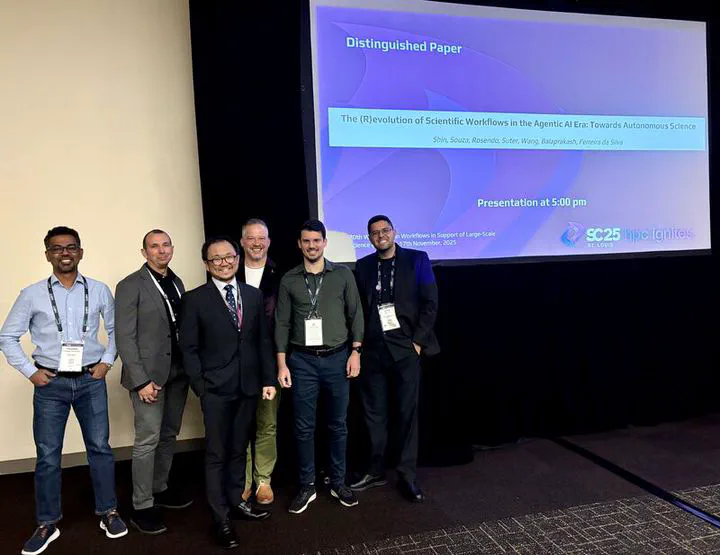
The (R)evolution of Scientific Workflows in the Agentic AI Era: Towards Autonomous Science
Nov 1, 2025·
 ,
,
,
,
,
,
·
1 min read
,
,
,
,
,
,
·
1 min read
Woong Shin
Renan Souza
Daniel Rosendo
Frédéric Suter
Feiyi Wang
Prasanna Balaprakash
Rafael Ferreira Da Silva
Abstract
Modern scientific discovery increasingly requires coordinating distributed facilities and heterogeneous resources, forcing researchers to act as manual workflow coordinators rather than scientists. Advances in AI leading to AI agents show exciting new opportunities that can accelerate scientific discovery by providing intelligence as a component in the ecosystem. However, it is unclear how this new capability would materialize and integrate in the real world. To address this, we propose a conceptual framework where workflows evolve along two dimensions—intelligence (from static to intelligent) and composition (from single to swarm)—to chart an evolutionary path from current workflow management systems to fully autonomous, distributed scientific laboratories. By embedding reasoning and adaptation into workflows, these labs have the potential to accelerate discovery by factors of 10 to 100, transforming exploratory science into a continuous, machine-augmented process.
Type
Publication
Proceedings of the 20th Workshop on Workflows in Support of Large-Scale Science (WORKS), held in conjunction with SC25
Distinguished Paper Award at WORKS'25